



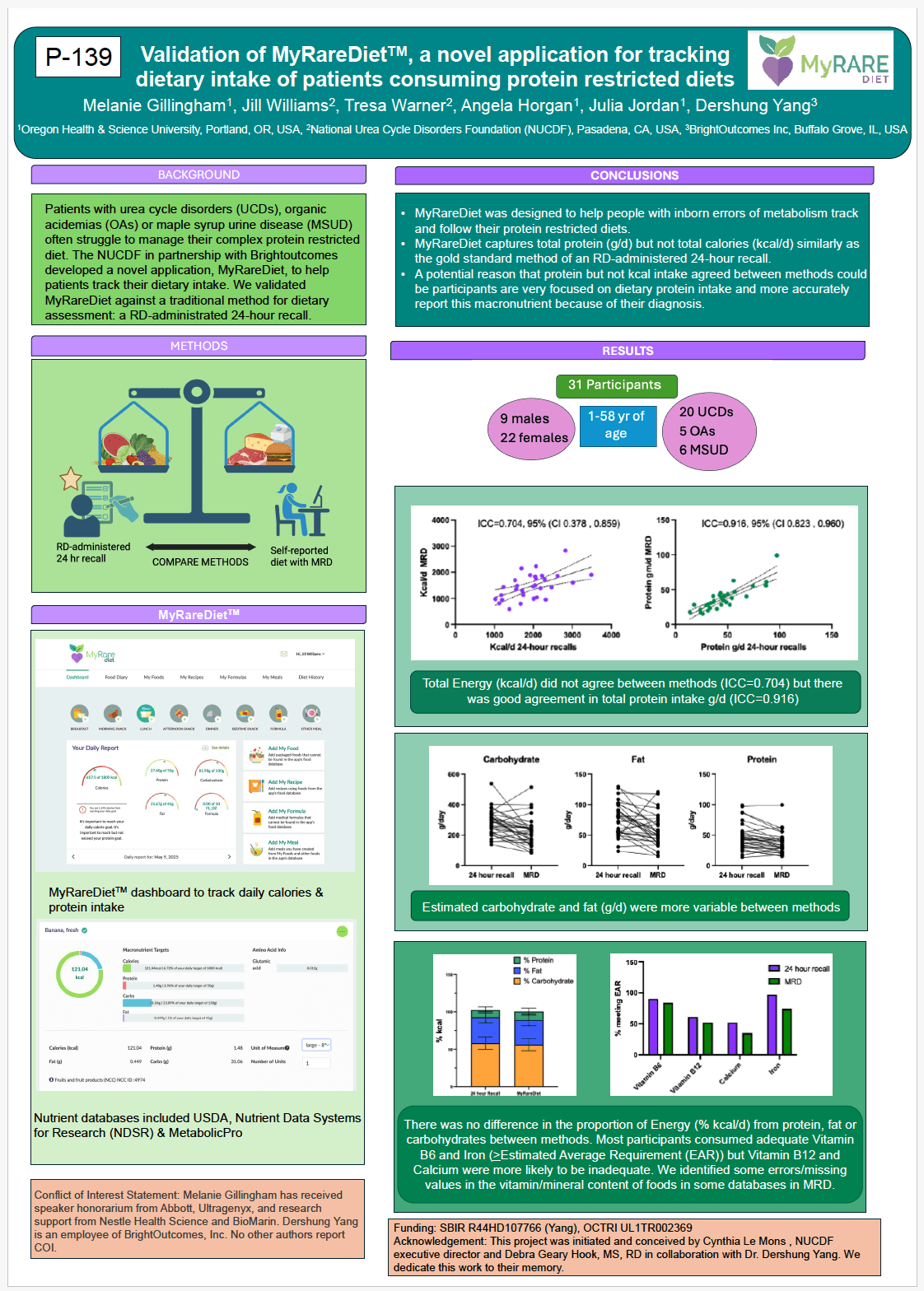
Scientific poster presented by Melanie Gillingham, PhD, RD, LD, of Oregon Health and Science University, presented in August 2026 at the Annual Symposium of the Society for the Study of Inborn Errors of Metabolism in Helsinki, Finland
For some patients with metabolic disorders, accurately tracking protein can be the difference between staying healthy and getting sick.
In 2025, NUCDF and its partners launched a validation study of MyRareDiet™, a digital app designed to help patients and families with urea cycle disorders (UCDs), organic acidemias, and maple syrup urine disease (MSUD) track their protein-restricted diets with more precision than typical food-logging apps offer. Last month, the lead investigator on the study, Melanie Gillingham, PhD, RD, LD, of Oregon Health and Science University, summarized the results of the study in a poster presented at the Annual Symposium of the Society for the Study of Inborn Errors of Metabolism (SSIEM) in Helsinki, Finland
The poster, "Validation of MyRareDiet™, a novel application for tracking dietary intake of patients consuming protein restricted diets," was authored by Dr. Gillingham and NUCDF's Jill Williams and Tresa Warner, OHSU's Angela Horgan and Julia Jordan, and Dr. DerShung Yang of BrightOutcome, Inc.
What the study did
Thirty-one participants—22 females and 9 males, ranging from 1 to 58 years old—took part in the validation study. It included 20 individuals with UCDs, 5 with organic acidemias, and 6 with MSUD. Each participant's dietary intake was assessed two ways: through a registered dietitian-administered 24-hour recall (the traditional research standard) and through self-reported logging in MyRareDiet. The research team then compared how closely the two methods lined up.
What they found
The results were encouraging, with an important nuance. Daily protein intake (grams per day) recorded in MyRareDiet agreed strongly with the 24-hour recall method. Total calorie intake, however, agreed less well between the two methods, and estimates of carbohydrate and fat intake were also more variable. Encouragingly, there was no meaningful difference between methods in the overall proportion of calories coming from protein, fat, and carbohydrates.
Most participants met their estimated needs for vitamin B6 and iron, while vitamin B12 and calcium were more likely to fall short. The team identified some gaps and errors in the micronutrient data within the app's food databases that will help guide future improvements.
Why might protein tracking be so much more accurate than calorie tracking? The research team hypothesized that people managing UCDs, organic acidemias, and MSUD live and breathe protein counting every single day. It's the number that keeps them safe, so it makes sense that it's also the number they report most precisely.
Why this matters
For families managing a protein-restricted diet, the daily math of grams, milligrams, and formula scoops is relentless. Despite this challenge, patients and families are estimating their protein intake similar to a dietitian conducting a 24-hour recall. We demonstrated MyRareDiet captures protein intake — the metric that matters most for metabolic safety — accurately while also giving patients and their metabolic teams a shareable picture of daily eating patterns. These findings will help the research team refine MyRareDiet's food databases and suggest it could be used to measure protein intake for both clinical care and future research studies. While future plans for the broader use of MyRareDiet are uncertain at this time, we are encouraged by these results and appreciate our community support for this project.
Honoring the vision behind MyRareDiet
This project began years ago with the vision of two people deeply missed by our community: dietitian Debra Geary Hook, MS, RD, and former NUCDF executive director Cynthia Le Mons. They imagined a tool that would make protein tracking easier for patients and families, and that would give children and teens with metabolic disorders more ownership over managing their own diets. Completing this validation study and sharing results with the international metabolic community at SSIEM is a tribute to their vision and legacy. We dedicate this work to their memory.
We're grateful to Dr. Gillingham and the OHSU bionutrition team, our partners at BrightOutcome, Inc., and every family who volunteered their time to help us study MyRareDiet as a potential tool for our community.
This research was supported by NIH SBIR grant R44HD107766 and OCTRI grant UL1TR002369.


