



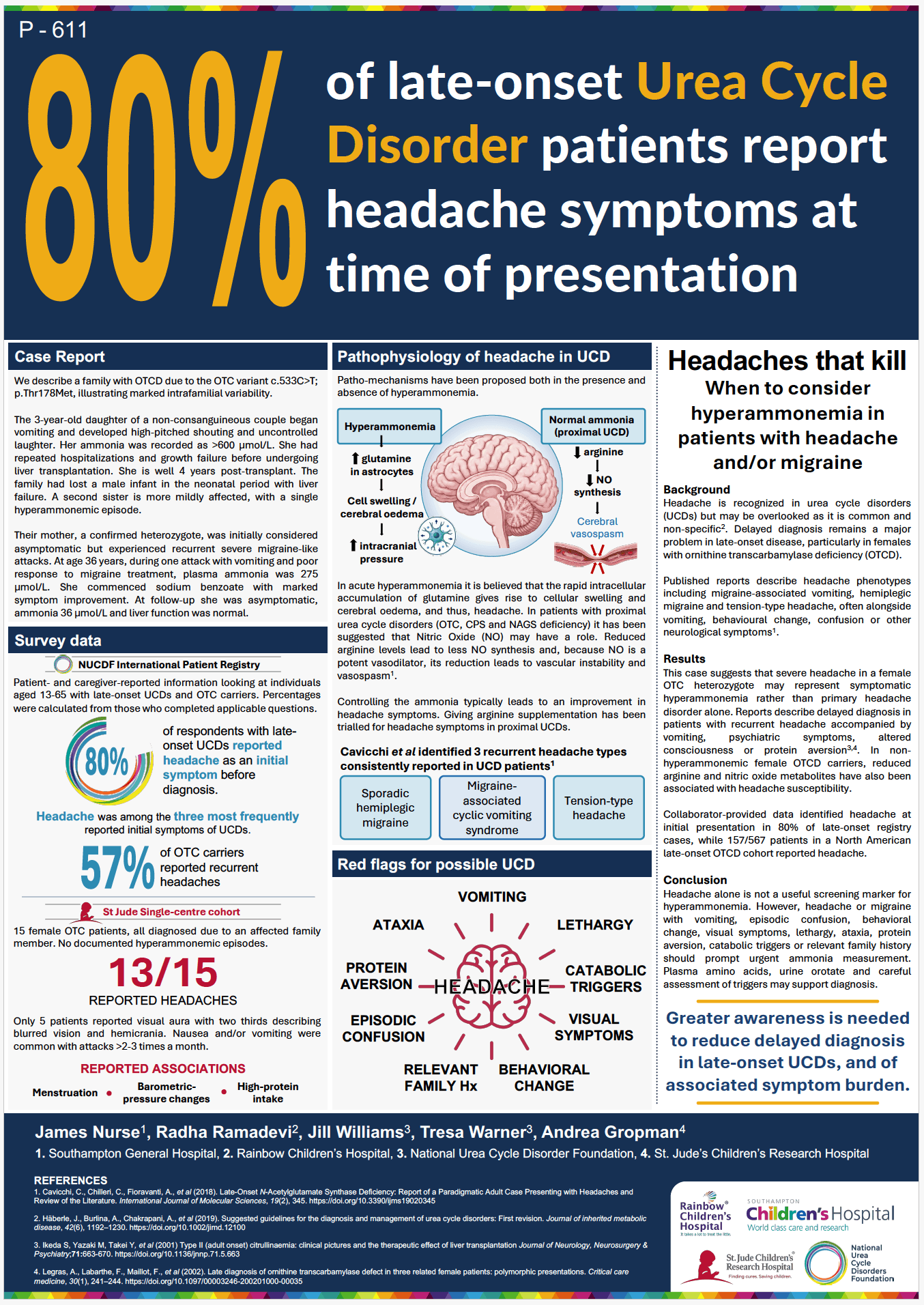
Scientific poster presented by Dr. James Nurse, a pediatrician at University Hospital Southampton in the United Kingdom, in August 2026 at the Annual Symposium of the Society for the Study of Inborn Errors of Metabolism in Helsinki, Finland
Sometimes research starts with a conversation.
Earlier this year, Dr. James Nurse, a pediatrician at University Hospital Southampton, was reading an article describing adults eventually diagnosed with late-onset ornithine transcarbamylase (OTC) deficiency, a urea cycle disorder (UCD). One patient's first complaint was something deceptively ordinary: migraine.
That got him thinking. Awareness campaigns about hyperammonemia (high blood ammonia) tend to focus on symptoms like confusion, vomiting, and altered consciousness. But how often does anyone second-guess a headache?
Dr. Nurse shared the observation on LinkedIn. His colleague Dr. Radha Ramadevi, a geneticist, replied with her own experience of OTC patients presenting with severe migraine episodes. That exchange caught the attention of NUCDF's Jill Williams and Tresa Warner. They pulled information from NUCDF's International Patient Registry and a related patient cohort, then brought in Dr. Andrea Gropman of St. Jude Children’s Research Hospital and a lead investigator on the Urea Cycle Disorders Consortium (UCDC) to confirm the findings held together clinically.
A few months later, that conversation had become a research poster, presented at the 2026 SSIEM Annual Symposium in Helsinki: *"Headaches that kill? When to consider hyperammonemia in patients with headache and/or migraine."
What the research found
The poster pulled together patient-reported data, a hospital case series, and a detailed family case report. Here's what stood out:
- 80% of NUCDF registry respondents with late-onset UCDs reported headache as one of their first symptoms, before they were ever diagnosed. It was among the three most reported early symptoms.
- 57% of OTC carriers—women who carry one altered copy of the OTC gene and are often assumed to be unaffected—reported recurrent headaches.
- In a group of 15 female OTC carriers with no known history of high-ammonia episodes, 13 reported headaches, often with visual disturbances, nausea, or vomiting several times a month.
- A separate large patient cohort found headache reported as an initial symptom in 157 of 567 people with late-onset OTC.
The poster also included the story of one family: a mother who carried the OTC gene change was thought to be unaffected, but had years of severe migraine-like episodes that didn't respond well to standard migraine treatment. During one particularly bad episode, a blood ammonia test revealed hyperammonemia. Once she started treatment, her headaches went away.
Why a headache might matter
Researchers have proposed two ways UCDs might cause headaches. During a high-ammonia episode, ammonia builds up quickly inside brain cells, causing swelling and pressure that can trigger headache. Separately, some UCDs lower the body's production of nitric oxide, a compound that normally keeps blood vessels relaxed. Less of it can make blood vessels unstable, which may contribute to headache or migraine even without a big ammonia spike.
What to watch for
The researchers are clear: a headache by itself isn't a reliable sign of a UCD—headaches are simply too common. But when a headache or migraine shows up alongside any of the following, it's worth asking a doctor about an ammonia test:
- Vomiting
- Episodic confusion
- Behavior changes
- Visual symptoms
- Unusual tiredness or lethargy
- Trouble with balance or coordination
- Avoiding protein-rich foods
- Recent illness, fasting, or other physical stress
- A family history of UCD
Why this story matters
This whole project started because one clinician noticed a pattern, said something about it publicly, and other people—a fellow physician, NUCDF staff, and a specialist—followed up. A conversation can raise a question, patient experience can help inform it, and collaboration can turn it into research. If that research helps even one clinician catch a UCD a little earlier, it's worth it.
If you or someone in your family has recurring headaches or migraines along with any of the symptoms above, talk to your doctor about a blood ammonia test. You can learn more, and find resources to share with your care team, at https://checkammonia.com.
Click here to download the poster.
Nurse, J., Ramadevi, R., Williams, J., Warner, T., & Gropman, A. (2026). *Headaches that kill? When to consider hyperammonemia in patients with headache and/or migraine.* Poster P-611 presented at the 2026 SSIEM Annual Symposium, Helsinki, Finland. Available at https://doi.org/10.13140/RG.2.2.11469.19681.


