


JULY 15, 2026 — In June 2025, the National Urea Cycle Disorders Foundation (NUCDF) launched the NUCDF Partner Network, a two-year, PCORI-funded project. The goals were to build a multi-stakeholder community around urea cycle disorder (UCD) research and to develop a roadmap that puts patient priorities at the center of future studies.
Today, as the project moves into its second year, NUCDF is sharing what we accomplished in Year One — and we exceeded our own goals.
But first, why this project? Urea cycle disorders are rare genetic diseases that can lead to coma, brain damage, and death. While investigator-driven research has improved survival rates and neurological outcomes, and new treatments including gene therapies and mRNA medicines are now in development, there has not been a formal effort to assess patient needs or meaningfully involve patients in shaping the research agenda.
At NUCDF, we hear this gap firsthand every day, from urgent questions about liver transplant versus emerging mRNA and gene therapies, to how best to transition care into adulthood.
The Partner Network was created to close that gap by building lasting infrastructure for patient-centered research in UCDs.
Rapid, diverse enrollment fueled network growth
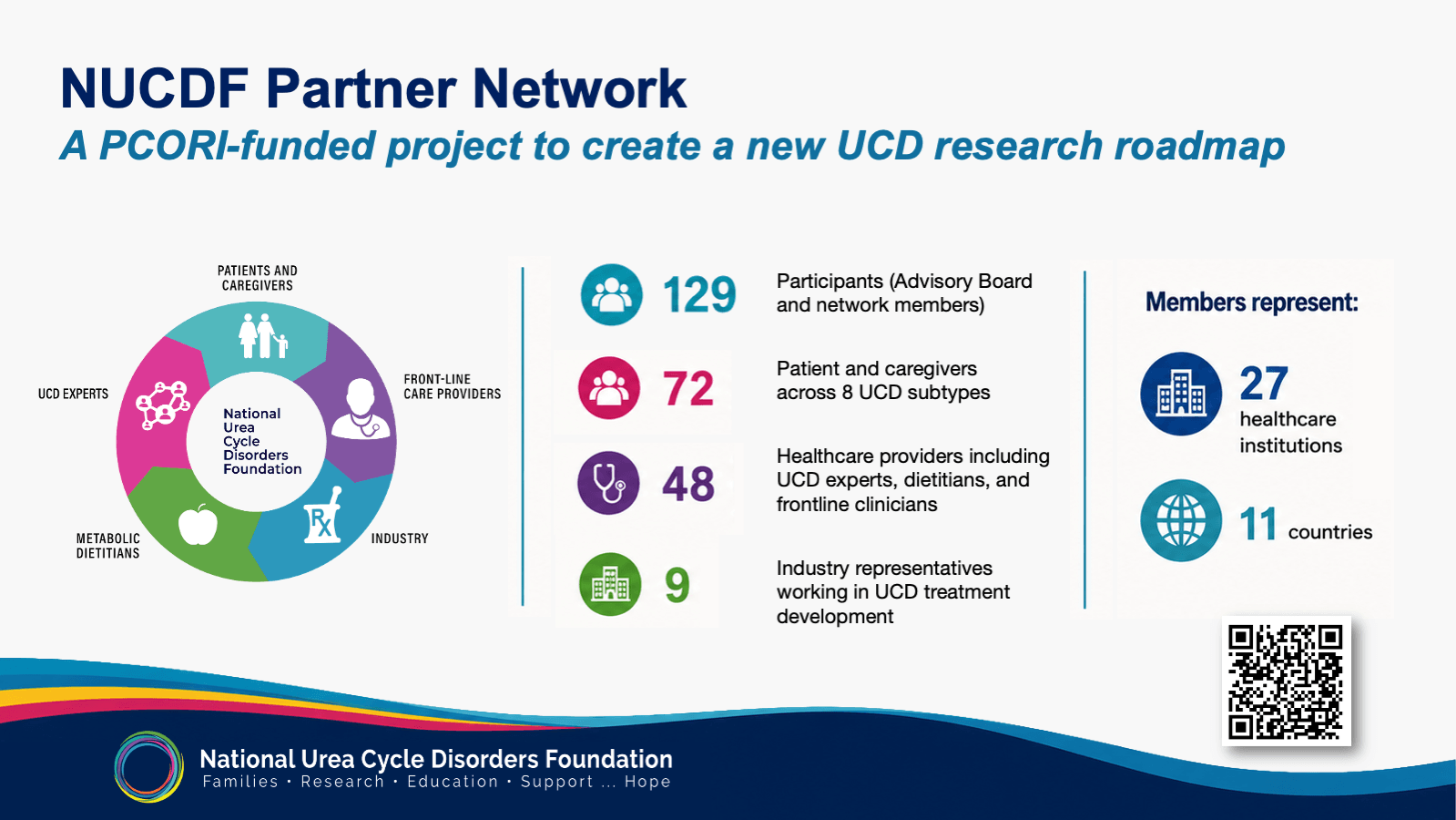
In Year One, NUCDF established a 17-member, multi-stakeholder Advisory Board representing all five targeted stakeholder groups: patients and caregivers, UCD experts, metabolic dietitians, front-line care providers, and industry representatives. The Advisory Board has met quarterly and provided guidance on recruitment, training design, and focus group planning.
Recruitment of network members exceeded goals in two categories: Patients and Caregivers, and UCD Experts, with the Patients and Caregivers goal met in just 15 days. In total, the project recruited 112 network members against a goal of 100.
Including the Advisory Board, the full Partner Network now totals 129 participants spanning 27 healthcare institutions and 11 countries, reflecting all eight UCD subtypes.
Training the community in patient-centered research
Network members attended a live or virtual orientation session in December 2025, then completed three virtual, 20-minute training modules on patient-centered research. Each module featured true patient stories and real UCD research examples to keep the content meaningful and relatable. Of the 112 network members, 82% completed all three training modules, and 76% of Advisory Board members did the same.
Listening through focus groups, surveys
Working closely with the Advisory Board, the project team developed focus group discussion guides tailored to each stakeholder group and offered ten live, virtual focus group sessions, with a written-feedback option for members who could not attend. A total of 62 network members participated in a live session and 15 submitted written responses, for an average participation rate of 69% across all stakeholder groups.*
“We set out to build a network that would truly reflect the UCD community. Year One showed us that community was eager to be heard,” said Tresa Warner, NUCDF’s executive director. “Reaching our recruitment goal for patients and caregivers in just 15 days told us everything we needed to know about how urgently families want a seat at the research table. Now, our job is to turn everything we’ve learned into a roadmap the whole field can use.”
Looking ahead to Year Two
With Year One data collection complete, the project now turns to analysis. In Year Two, the team will draft a list of research needs based on the focus group findings, conduct a prioritization survey with network members, and develop and disseminate a new research roadmap for UCDs.
A final project activity, sustainability, will focus on keeping the Partner Network active well beyond the life of this project so that all stakeholder groups can continue to engage in UCD research over the long term.
Want to be part of Year Two? Visit nucdf.org/partner-network to learn more, join our email list, or email partner@nucdf.org with questions.
About Urea Cycle Disorders (UCDs)
Urea cycle disorders are eight related disorders caused by genetic mutations that lead to deficiencies in enzymes or transporters crucial to removing ammonia, a toxic byproduct of protein metabolism, from the bloodstream. They are estimated to affect approximately 1 in 35,000 people.
About the National Urea Cycle Disorders Foundation (NUCDF)
NUCDF is a nonprofit organization dedicated to saving and improving the lives of children and adults affected by urea cycle disorders and raising awareness since 1988. Led exclusively by patients and families affected by UCDs, NUCDF is the driving force behind critical research to improve the understanding and management of UCDs, find new treatments, and ultimately create a cure. Visit www.nucdf.org or email info@nucdf.org.
*Focus group participation totals were updated as of 9/8/2026.
The NUCDF Partner Network is funded through a Patient-Centered Outcomes Research Institute® (PCORI) Eugene Washington PCORI Engagement Award (EASO-42342). The statements presented here are solely the responsibility of the authors and do not necessarily represent the views of PCORI®.


