


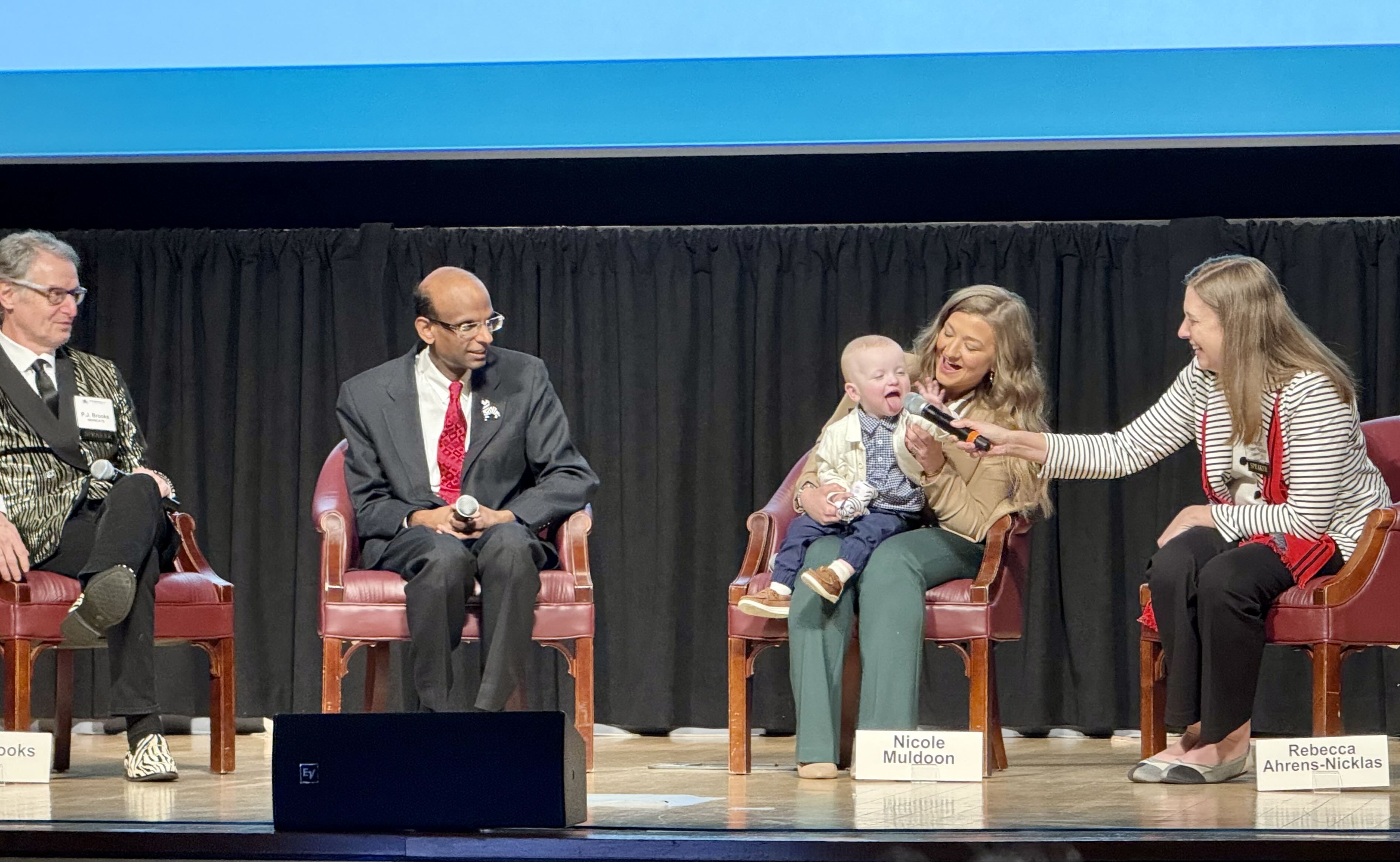
From left, P.J. Brooks, PhD, of the NIH's National Center for Advancing Translational Sciences, Dr. Kiran Musunuru, Nicole Muldoon, mother of KJ Muldoon (on her lap), and Dr. Rebecca Ahrens-Nicklas.
The successful treatment of KJ Muldoon with a personalized CRISPR gene-editing therapy for a urea cycle disorder called CPS1 deficiency was featured in a closing session of this year's Rare Disease Day at NIH event. The panelists told the story of KJ's treatment and discussed ongoing efforts to make similar treatments available to more patients.
KJ, who is now walking, stole the show when he joined his mom and the physician-scientists on stage. The event featured NIH's P.J. Brooks, PhD, Nicole Muldoon, KJ's mom, and the physicians who led development of his treatment, Dr. Kiran Musunuru and Dr. Rebecca Ahrens-Nicklas.
While KJ's CPS1 deficiency was not "cured" by the first-in-human therapy, he now has a much milder form of the disease. For his full story, read our earlier article and updates.
February 25 marked the one-year anniversary of KJ's first CRISPR treatment. His mom, Nicole Muldoon, reported that KJ is thriving. This video from Children's Hospital of Philadelphia highlights his progress. "He's been meeting milestones," she said. "His protein intake is well above what we ever thought it could be for his age. He's doing really, really well."
From heart disease to rare disease
Dr. Musunuru and his team at the University of Pennsylvania initially began using CRISPR to treat heart disease, targeting cholesterol genes in the liver. Several companies are now working to commercialize the technology. As a next step, Dr. Musunuru approached his colleague Dr. Ahrens-Nicklas at Children's Hospital of Philadelphia about applying the approach to rare diseases.
Why rare diseases? "CRISPR is an eminently programmable technology," he says. One of its components is a small molecule that has sequencing coded in it almost like a GPS, which directs the CRISPR machine to the site in the DNA to be edited. "All you need to do is change that GPS to a different address, point it at another gene, and then all of a sudden, you have a treatment that you can apply in the service of patients with rare diseases."
The liver is currently the best target for the gene editing therapy, he said. "We wish [the gene editor] would go other places, and eventually we'll get there, but it goes to the liver because the liver's role in the body is to clean things out of the blood." As a result, the infused "soap bubbles"—lipid nanoparticles encasing the gene editor—are able to reach liver cells and deliver the gene editing cargo.
The team initially used mouse models for PKU, an inherited metabolic disorder, to develop the technology with good results. "When we saw this PKU data, we really felt like we had to figure out a way to deploy this to the populations that needed it most," said Dr. Ahrens-Nicklas. "I think a lot about the ethics and how you decide where you start, because is a novel therapy. It's never been personalized for an infant."
"In my mind, I immediately wanted to work on urea cycle disorders," she said. "As a clinical geneticist, I unfortunately had the experience of working with a lot of urea cycle disorder families where the outcome, in all honesty, was not the outcome we would have hoped for." KJ's disorder, CPS1 deficiency, is an incredibly severe disease, she said. "Fifty percent of infants die in the first week of life."
It took them them 18 months to develop the treatment in their PKU work. "Eighteen months was going to be way too long to help a kid like KJ. So with practice, and with a lot of really hard work from very talented graduate students and others, we got the timeline down," she said. Their goal was to develop a personalized therapy more quickly than it would take for a child to grow big enough for a liver transplant—typically about 6 months—to make a meaningful clinical difference.
Helping KJ
When KJ was born in August of 2024, the team believed that they had the treatment development timeline fast enough to try to treat someone for the first time. With his particular variant, KJ essentially made no CPS1 protein, which meant he had the most severe case of the most severe urea cycle disorder subtype.
The physicians worked carefully with their medical ethics colleagues before asking KJ’s family if they had an interest in research.
Dr. Ahrens-Nicklas approached them about it on a Friday night. "It was one of those conversations as a physician that I will never forget," she said.
After first discussing the implications for KJ’s care, the Muldoons asked what this research would mean for the broader UCD community: “What will you be able to do with this information that you learn to help others, even if we decide liver transplant is the best option for our son?” they asked.
The family made a list of questions and requested a team meeting with the specialists working on his case to learn more. Ultimately, they decided to proceed. Key factors in their decision included how metabolically fragile KJ was, uncertainty over the timeline to liver transplant, and their desire to protect his brain from more elevated ammonias.
The team began development of a gene editing treatment for KJ even as he was listed for transplant. "If a liver became available first, it would have been great for him, and we would have been very excited about that," said Dr. Ahrens-Nicklas.
She emphasized that they did not have a single informed consent conversation with the Muldoons, but rather many: “Anytime you’re dealing with a parent or a family that’s trying to make really tough decisions about their child and a life-threatening illness, informed consent is difficult," she said. "We chatted over the course of the entire time we were doing this project for four months.”
On the day of KJ's first three-hour infusion, his parents along with Dr. Ahrens-Nicklas and Dr. Musunuru stayed in his room. KJ slept while the others endured the terror and hope of waiting, calling it the longest three hours of their lives. As we now know, KJ's treatment succeeded. It was announced publicly in May 2025.
Aiming to help more patients
After the announcement, the physicians received literally thousands of requests from patients with a wide variety of rare diseases. “The majority of them are not things we are in position to tackle now. At this point, we’re only really able to target the liver. Work is underway to expand to other delivery targets,” said Dr. Musunuru.
To bring the treatment to more patients, the two physicians began having interactions with the U.S. Food and Drug Administration (FDA), working toward bundling together seven of the UCD subtypes into an “umbrella” clinical trial. “They were supportive of that,” said Dr. Musunuru. “We have felt very encouraged by the interactions we’ve had with the FDA."
The physicians are transparently sharing their interactions with the FDA in articles like this one in order to help move the technology forward. They hope to receive clearance for an umbrella trial soon.
Since KJ's successful treatment, the FDA has responded by outlining a new "plausible mechanism" pathway that offers a faster route to approval for rare disease treatments. They also published guidance on the pathway during Rare Disease Week on February 23.
Traditional drug development requires a single drug to be tested through a randomized clinical trial. Such trials would not be feasible for individualized gene editing therapies—clinical trials are expensive, slow, and require a large patient population. The plausible mechanism framework would allow for smaller, highly tailored clinical studies where genetic or molecular alterations are directly targeted by a therapy.
During the Rare Disease Day at NIH event, Drs. Musunuru and Ahrens-Nicklas met with FDA to discuss their proposed clinical trial further. They reported that it was a positive meeting; they hope to share those interactions as soon as possible.
They thanked several groups for the pivotal role they played in the treatment development, including:
- The foundational knowledge about UCDs built by the Urea Cycle Disorders Consortium in its natural history study, funded under the NIH’s Rare Diseases Clinical Research Network.
- The extensive support from the NIH's Somatic Cell Gene Editing Consortium, which is co-led by P.J. Brooks, the session moderator.
- The Food and Drug Administration: “Our interactions with FDA, our work with the career staff… have been wonderful,” said Dr. Musunuru. “They’re great partners. They’ve been willing to work with us, they understand what we’re trying to do, while still exercising caution and rigor."
- Dr. Ahrens-Nicklas particularly praised the neonatologist who ordered an ammonia test when KJ was only about 24 hours old for taking that critical first step in achieving a successful outcome.
Read more
"A Year After First-in-World Gene-Editing Therapy, CHOP-Penn Team Aims to Scale the Science," by Lauren Ingeno. Cornerstone Blog, Children's Hospital of Philadelphia Research Institute, February 26, 2026. https://www.research.chop.edu/cornerstone-blog/a-year-after-first-in-world-gene-editing-therapy-chop-penn-team-aims-to-scale-the-science


