Rare Disease Week 2026 kicked on Monday, Feb. 23 with a special NUCDF ECHO® session, an announcement from the U.S. Food and Drug Administration about a new approval pathway for rare disease treatments, and the approval of pegzilarginase, a treatment for Arginase 1 Deficiency. More events are planned to continue shining a light on urea cycle disorder patients and the challenges facing the more than 300 million people globally living with a rare disease.
Monday evening, NUCDF hosted a special ECHO® educational program for clinicians focused on urea cycle disorders (UCDs). It featured personal stories shared by individuals and families impacted by UCDs. A recording from the event is available here:
Historic News For The ARG1-D Community
A huge congratulations to the Arginase 1 Deficiency community! On Feb. 23, the U.S. Food and Drug Administration approved Pegzilarginase (Loargys)—the first and only treatment for Arginase 1 Deficiency (ARG1-D), which is a urea cycle disorder. "This is not just a milestone. This is hope realized," said Christine Zahn of the Arginase 1 Deficiency Foundation in a post.
"For families living with ARG1-D, this approval represents something we have waited for, worked toward, advocated for, and prayed over for years — a treatment that can lower toxic arginine levels and help slow the devastating progression of this ultra-rare disease."
NUCDF helped fund early preclinical work at Baylor College of Medicine that was foundational to the development of this treatment and also helped organize an early patient meeting to gather community input. We are grateful that this treatment will soon be more easily available to the patient community.
FDA Proposes Guidance for New Rare Disease Treatment Approval Pathway
Earlier in the day, the U.S. Food and Drug Administration announced proposed guidance on the FDA's "plausible mechanism pathway," a new route to approval for treatments of rare diseases like urea cycle disorders.
The proposed guidance describes approval requirements for new rare disease therapies—like gene editing and RNA-based therapies such as antisense oligonucleotides—when randomized controlled trials are not feasible due to small patient populations. The treatment of baby KJ Muldoon with the first-ever personalized CRISPR gene-editing therapy in 2025 is an example of such a new therapy. KJ has the urea cycle disorder CPS1 deficiency,
The scientists from the Children's Hospital of Philadelphia who led the development of KJ's treatment, Rebecca Ahrens-Nicklas and Kiran Musunuru, joined an FDA event yesterday announcing the new guidance. They shared their hopes for making KJ's specialized therapy more broadly available.
"We'll be continuing our work with the FDA using the plausible mechanism framework that's being published today, with a goal of getting to an approval of this platform as efficiently as possible, and getting individualized treatments for the urea cycle disorders to all the patients in the U.S. who could benefit from them," said Dr. Musunuru. "But that's just the first step. We intend to expand this work to many other liver-centered diseases, and as we go forward, we'll share our learnings with everyone in the hope that when scientists develop technologies to get this kind of therapy to many organs besides the liver, it will allow doctors to treat many, many rare diseases by getting at their root causes."
Dr. Ahrens-Nicklas also spoke at the event, welcoming the guidance. "Kiran and I have received thousands of requests from desperate families asking for our help. As a scientist, a physician and a mom, this is heartbreaking. We really need to do better," she said.
"With this opportunity will come great responsibility," she added. "When developing therapies using this framework, every single piece of data from every patient is priceless. We already know this in the world of rare diseases, but it will be even more true now, and I hope that we can all proceed with radical transparency and share all that we learn, both the triumphs and the struggles as we build this field of interventional genetics. It's really the only way we will truly honor our rare disease patients."
More Rare Disease Week Events
NUCDF will continue sharing informational materials and patient stories throughout Rare Disease Week to raise awareness about rare diseases and UCDs. In addition:
- NUCDF staff will attend the Bi-Annual Meeting of the National Institutes of Health’s Rare Diseases Clinical Research Network together with our research partner, the Urea Cycle Disorders Consortium.
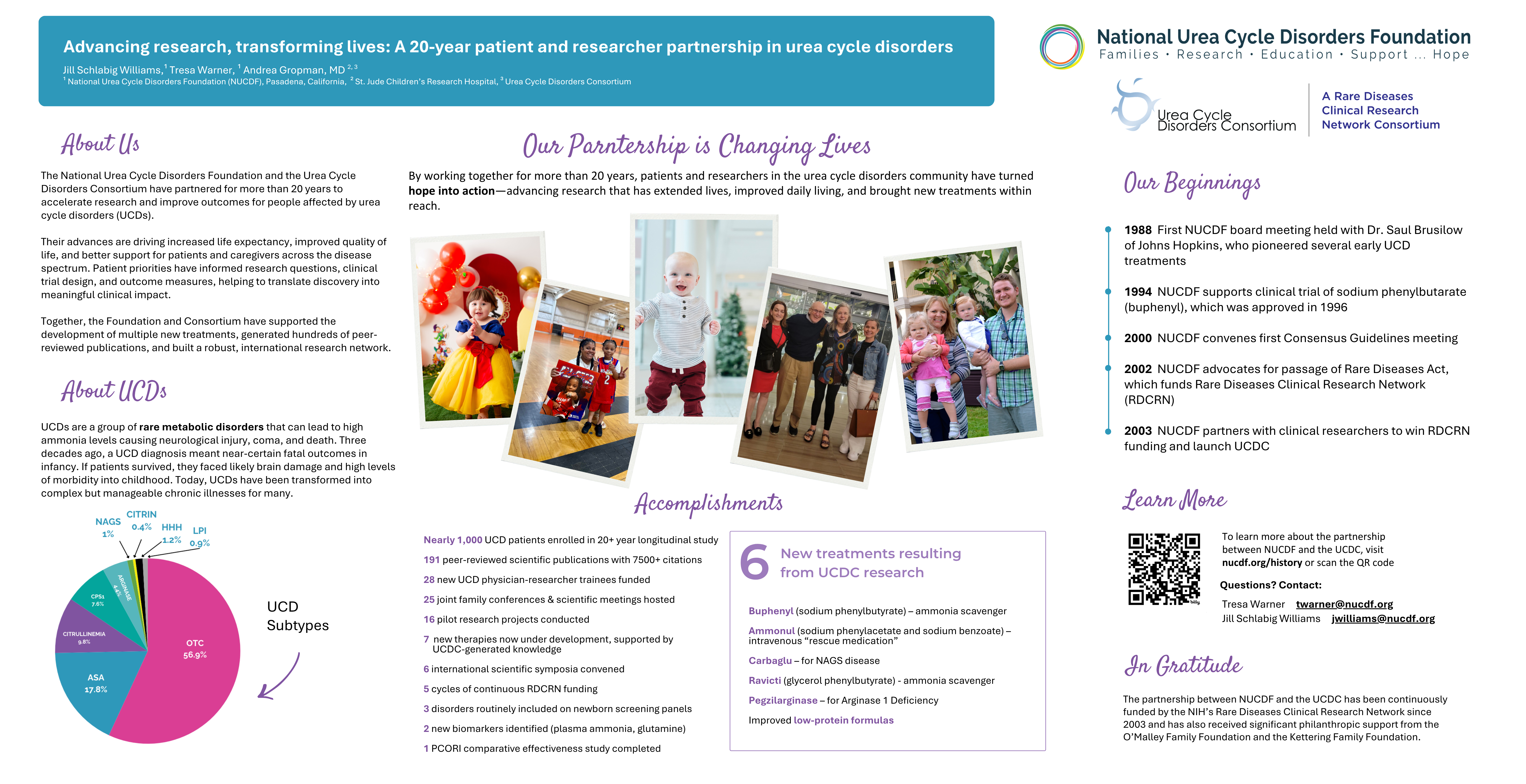
- NUCDF and the UCD Consortium will present a poster and staff an informational table at Rare Disease Day at NIH on Friday, February 27 in Bethesda, MD.
The full Rare Disease Day at NIH program will be live streamed. To view the agenda and register to attend, visit https://ncats.nih.gov/news-events/events/rdd.
NUCDF encourages supporters to honor Rare Disease Day by:
- Learning more about Urea Cycle Disorders
- Following and sharing our materials on Facebook and LinkedIn (@NUCDF) as well as Instagram (@cureucd)
- Reading and sharing UCD patient stories
- Sharing educational resources like NUCDF’s Check Ammonia campaign and Rare Disease Day materials to spread awareness
- Supporting NUCDF and rare disease research
- Standing in solidarity with individuals and families affected by UCDs
NUCDF works year-round to support patients and families impacted by UCDs through education, advocacy, research funding, and community-building initiatives. On Rare Disease Day, the Foundation is calling on the public, healthcare professionals, policymakers, and researchers to help accelerate progress toward earlier diagnosis, improved treatments, and ultimately, cures.
To learn more about urea cycle disorders or how to support the UCD community, visit www.nucdf.org.
Joint NUCDF-UCDC poster presented at Rare Disease Day at NIH, 2026