


In recognition of Rare Disease Day, the National Urea Cycle Disorders Foundation (NUCDF) is joining the global rare disease community to raise awareness by hosting a special ECHO® educational program for clinicians focused on urea cycle disorders (UCDs). These rare, life-threatening genetic metabolic conditions impact the body’s ability to remove ammonia from the bloodstream. Rare Disease Day is observed annually on February 28 (or February 29 in leap years),
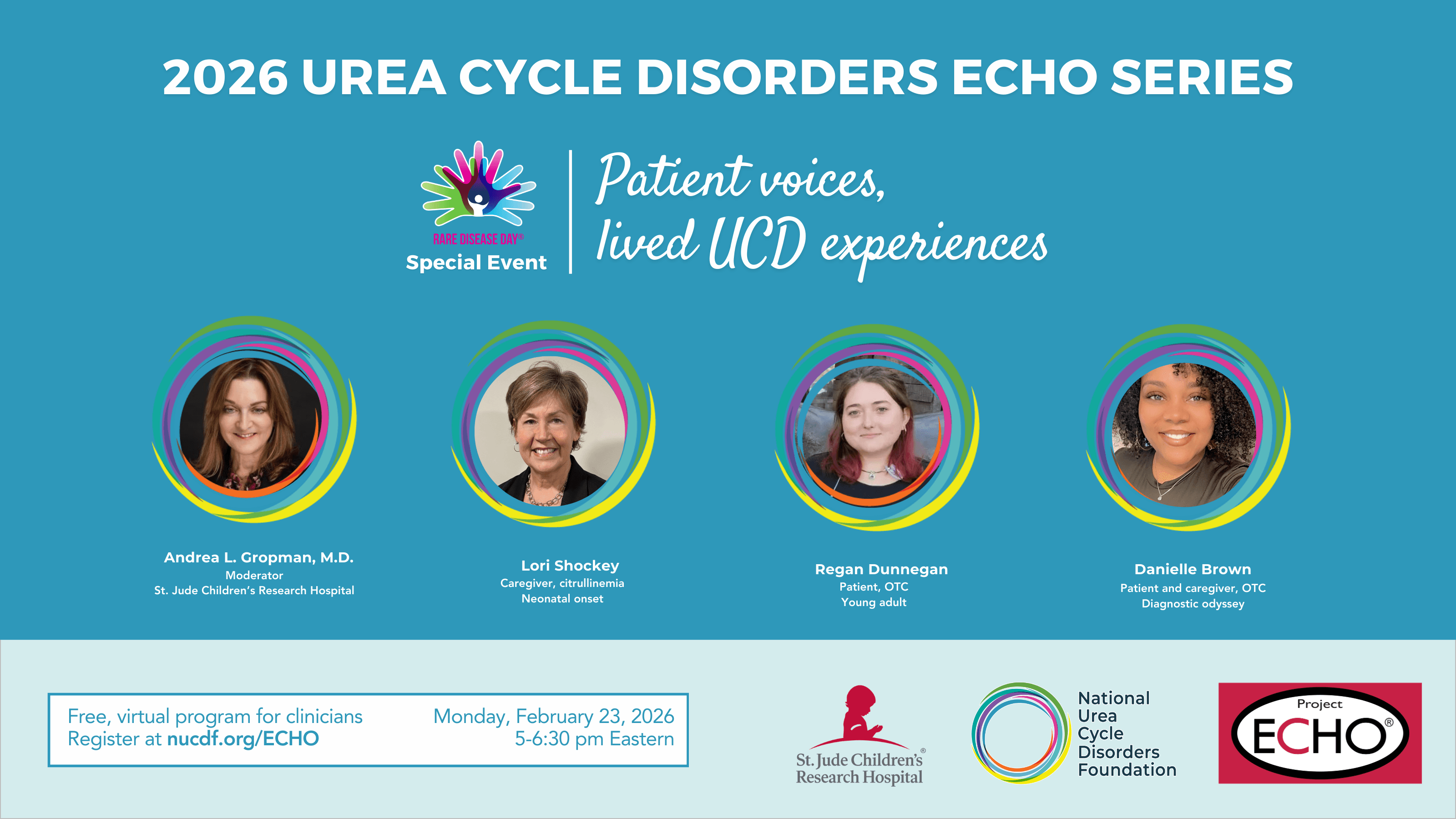
The ECHO session will take place on Monday, February 23 from 5-6:30 pm Eastern. It will feature personal stories shared by individuals and families impacted by UCDs. The goal is to raise awareness of the lived experiences of individuals with UCDs and highlight the importance of the patient voice and perspectives in patient care. Visit nucdf.org/echo to register. Note: Continuing medical education credits will not be offered for this session.
The program, the first in NUCDF’s 2026 Urea Cycle Disorders ECHO® Series, will be moderated by Dr. Andrea Gropman of the Pediatric Translational Neuroscience Initiative at St. Jude Children’s Research Hospital. Dr. Gropman is also the co-principal investigator of the NIH-funded Urea Cyle Disorders Consortium (UCDC), NUCDF’s research partner. Learning objectives include:
- Highlighting the importance of the patient voice and perspective in care
- Understanding the experience and impact of an infant-onset diagnosis
- Exploring the diagnostic odyssey experience
- Discussing considerations in treatment decision-making.
The following patients and caregivers will be sharing their stories at the session:
- Neonatal onset: Lori Shockey, caregiver, citrullinemia
- Young adult: Regan Dunnegan, OTC
- Diagnostic odyssey: Danielle Brown, patient and caregiver, OTC
Information on additional events in the 2026 series will be announced as plans are finalized.
More Rare Disease Day Events
“Rare Disease Day is an opportunity to amplify the voices of the UCD community and remind the world that rare does not mean insignificant,” said Tresa Warner, Executive Director of NUCDF. “Families affected by UCDs face daily challenges—from medical emergencies to lifelong management—and they deserve visibility, understanding, and support.”
Urea cycle disorders affect individuals from infancy through adulthood. If left undiagnosed or untreated, UCDs can lead to severe neurological damage, coma, or death.
Leading up to Rare Disease Day, NUCDF will be sharing informational materials and patient stories to raise awareness about rare diseases and UCDs across our social media channels. In addition:
- NUCDF staff will attend the Bi-Annual Meeting of the National Institutes of Health’s Rare Diseases Clinical Research Network together with our research partner, the Urea Cycle Disorders Consortium.
- NUCDF and the UCD Consortium will present a poster and staff an informational table at Rare Disease Day at NIH on Friday, February 27, in Bethesda, MD.
The groundbreaking treatment of baby KJ Muldoon in 2025 with the first-ever personalized CRISPR gene-editing therapy will be on the agenda at the Rare Disease Day at NIH event. Lead scientists Rebecca Ahrens-Nicklas and Kiran Musunuru will join an afternoon panel on “Gene Therapy — Recent Approvals, Success Stories and Patient Perspectives.” KJ was born with the rare urea cycle disorder CPS1 deficiency. The extensive natural history study and other research conducted by the NIH-funded UCD Consortium helped provide the foundational knowledge about UCDs and CPS1 needed to develop KJ’s treatment and measure its success.
The 20-plus year partnership between NUCDF and the UCD Consortium has resulted in the development of multiple new UCD treatments, hundreds of scientific papers, the longest-running sustained natural history study of any group of inherited metabolic disorders, and a significant increase in both the lifespan and quality of life of UCD patients.
Help Raise Awareness
Urea cycle disorders are eight related disorders caused by genetic mutations that lead to deficiencies in enzymes or transporters crucial to removing ammonia, a toxic byproduct of protein metabolism, from the bloodstream. UCDs are estimated to affect approximately 1 in 35,000 people.
Globally, more than 300 million people live with a rare disease, and nearly half are children. While each rare disease may affect a small population, together they represent a significant public health issue.
“This day reminds us that collaboration is critical,” added Warner. “Progress in rare disease research and care depends on awareness, funding, and collective action.”
NUCDF encourages supporters to honor Rare Disease Day by:
- Learning more about Urea Cycle Disorders
- Following and sharing our materials on Facebook and LinkedIn (@NUCDF) as well as Instagram (@cureucd)
- Reading and sharing UCD patient stories
- Sharing educational resources like NUCDF’s Check Ammonia campaign and Rare Disease Day materials to spread awareness
- Supporting NUCDF and rare disease research
- Standing in solidarity with individuals and families affected by UCDs
NUCDF works year-round to support patients and families impacted by UCDs through education, advocacy, research funding, and community-building initiatives. On Rare Disease Day, the Foundation is calling on the public, healthcare professionals, policymakers, and researchers to help accelerate progress toward earlier diagnosis, improved treatments, and ultimately, cures.
To learn more about urea cycle disorders or how to support the UCD community, visit www.nucdf.org.
About the National Urea Cycle Disorders Foundation The National Urea Cycle Disorders Foundation (NUCDF) is dedicated to saving and improving the lives of children and adults affected by Urea Cycle Disorders. Through education, advocacy, research funding, and family support, NUCDF works to increase awareness, advance treatments, and foster a strong, connected community.
About the series The Urea Cycle Disorders ECHO program is offered by the National Urea Cycle Disorders Foundation (NUCDF), a nonprofit patient group that advocates for people affected by UCDs. Since 1988, we have been working to advance research, improve care, and raise awareness that saves lives. Our partners in this effort are the experts of the Urea Cycle Disorders Consortium (UCDC), an NIH-funded group of researchers and clinicians across 16 academic institutions in the U.S., Canada, and Europe. For more information, contact NUCDF at info@nucdf.org.
Project ECHO (Extension for Community Healthcare Outcomes) is an innovative tele-mentoring program designed to create virtual communities of learners by bringing together healthcare providers and subject matter experts using videoconference technology, brief lecture presentations, and case-based learning, fostering an “all learn, all teach” approach and democratization of knowledge. Learn more.
The Pediatric Translational Neuroscience Initiative (PTNI) at St. Jude is committed to transforming the treatment landscape for children living with catastrophic pediatric neurological disorders, bridging fundamental science and experimental neurotherapeutics. PTNI works closely with stakeholders across multiple sectors, including other researchers and institutions, patient and community groups, industry, and policymakers, to identify promising paths forward in pediatric neuroscience. Learn more.


