



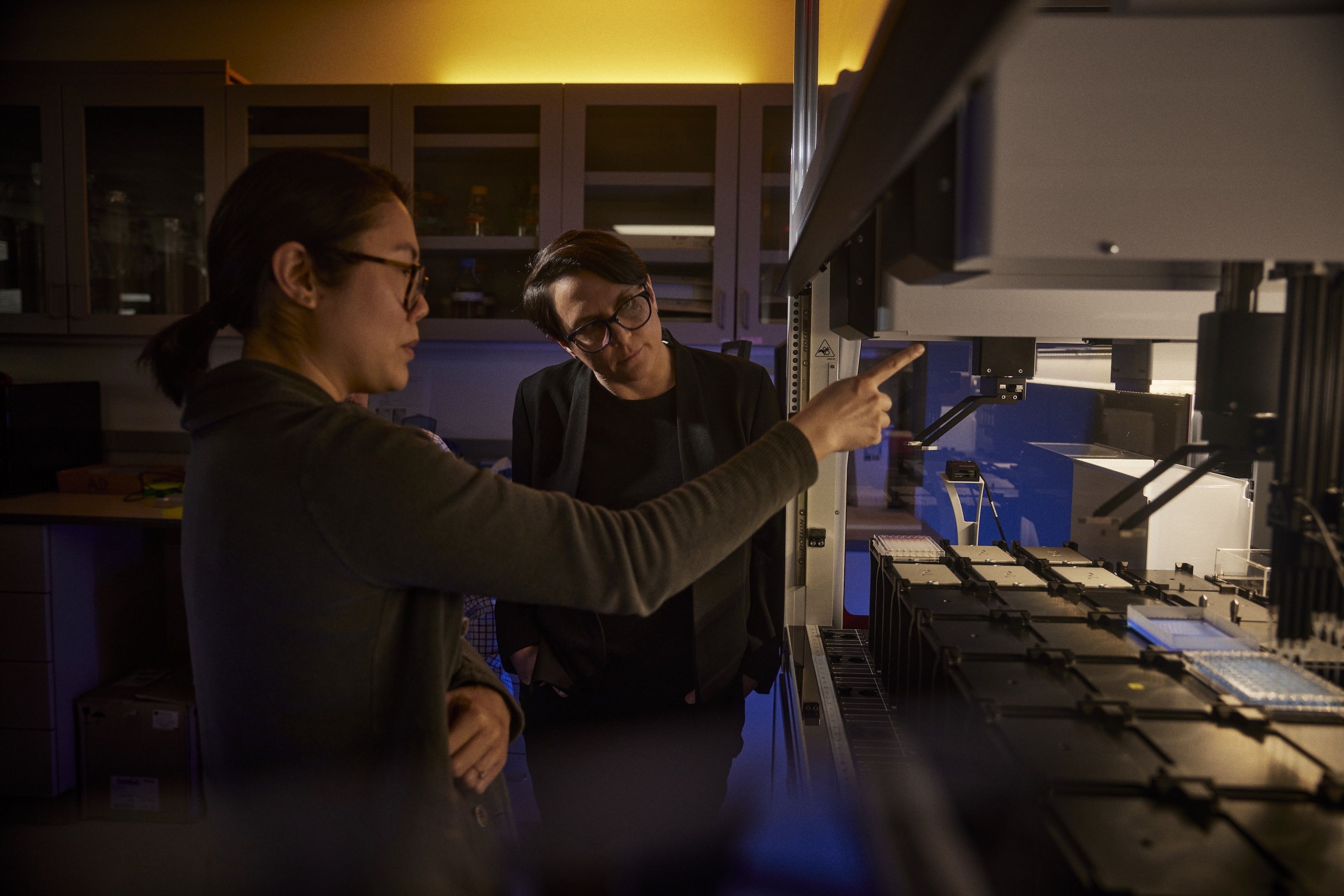
Drs. Michelle Tang and Aimée Dudley in the Dudley Lab, where a robot streamlines genetic sample processing. Photo courtesy of Pacific Northwest Research Insitute.
In 2023, Aimée Dudley, PhD, and her colleagues published an important paper that shed light on “variants of uncertain significance”—genetic changes that may or may not cause disease—after measuring the activity of 1,570 human OTC variants, ranking them by severity, and evaluating how well results agreed with the experiences of human patients. Her team collaborated with researchers from the Urea Cycle Disorders Consortium and other experts and shared the results with the NUCDF community.
Now, Michelle Tang, PhD—a scientist in Dr. Dudley’s lab—has completed a similar analysis of variants causing the urea cycle disorder ASL (arginosuccinate lyase, also known as arginosuccinic aciduria or ASA). She measured the effect of 2,426 individual ASL variants and similarly ranked them by severity, creating a new dataset.
Dr. Tang also made a groundbreaking discovery: It has long been believed in genetics that inheriting two harmful variants in the same gene always worsens the disease. Instead, Dr. Tang and her colleagues found that, in many cases, two harmful variants can actually restore normal protein function, making a disease less severe than what would be expected.
This new study is the first to systemically test a phenomenon called “intragenic complementation,” which was proposed in 1964 by Francis Crick and Leslie Orgel. They theorized that one harmful variant could be offset by another harmful variant in a different part of the same protein, based on the structural characteristics of the proteins. The phenomenon was assumed to happen only rarely.
“There have been sporadic reports of intragenic complementation in ASL involving only a small number of variants,” says Dr. Dudley. “Since we do experiments now at a much larger scale, Michelle was interested in exploring this phenomenon. We had the tools available to do it: a large collection of ASL variants, a yeast system that allows you to combine two variants in the same cell, and the ability to build an AI model to make predictions.”
They experimentally measured the functional impact of several thousand individual ASL variants and then mated selected variants to create combinations, discovering that a surprising 60% of variant pairs that would be damaging individually could, together, bring enzyme activity back to healthy levels.
The team then used their data set to develop and test an AI model that was able to accurately forecast whether two variants would restore protein function. The model achieved nearly 100% accuracy in predicting intragenic complementation in ASL. They also tested the model on another human enzyme, fumarase, and achieved similar results, suggesting that these rules apply broadly across the human genome for structurally similar proteins.
“This phenomenon is not rare,” says Dr. Dudley. “It was pervasive for ASL.” She estimates that at least 4% of all human genes have the structural features that allow this type of interaction, making it essential that predictions of variant outcomes consider the impacts of intragenic complementation.
Dr. Dudley and her team hope to perform yeast studies on all eight UCD genes. They have already observed intragenic complementation in the ASS1 (citrullinemia) gene.
Next steps
The team is continuing to study the impacts of UCD variants using yeast genetics, in collaboration with physicians and other experts. Results detailing individual ASA/ASL variant impacts will be added to the National Institutes of Health’s ClinVar database, which aggregates information about genomic variation and its relationship to human health.
Reporting cross-gene interactions will be more difficult, however, because databases like ClinVar only include data on individual variants, not interactions. Beyond individual papers, there is currently no direct way to share these gene interaction data with practicing physicians.
“I think our study underscores the importance of considering the effect of genetic variants in context,” says Dr. Dudley. “If phenomena like intragenic complementation only happened for a small number of genes or variants and the effects weren’t very strong, perhaps we wouldn’t need to worry about them. But because the effects of these combinations can be striking and because they can occur with many combinations and in many genes, this is something that researchers, clinicians, genetic counselors, and patients need to consider.”
What physicians should know
- The intragenic complementation phenomenon is more common than previously thought; approximately 4% of human genes have the structural features that allow this type of interaction.
- For these genes, standard predictions can overestimate disease risk.
- The rules for when intragenic complementation occurs can be understood and applied to create accurate predictions.
What patients should know
- Patients looking to better understand the impact of ASA/ASL variants should share this paper with their physician or genetic counselor.
Measured and machine learning-predicted yeast growth estimates are available for free to academic researchers under a limited license for noncommercial use. See the full paper for details.
Tang, M., Cromie, G. A., Kabir, A., Timour, M. S., Ashmead, J., Lo, R. S., Corley, N., DiMaio, F., Morizono, H., Caldovic, L., Ah Mew, N., Gropman, A., Shehu, A., & Dudley, A. M. (2026). Predicting epistasis across proteins by structural logic. Proceedings of the National Academy of Sciences of the United States of America, 123(3), e2516291123. https://doi.org/10.1073/pnas.2516291123


